Current Exercise
Writing Exercises 1-20 are on this page.
Exercises 1- 20
Exercises 21- 40
Exercses 41 - 60
Exercises 61-80
Exercises 81-100
Exercises 101 - 120
Exercises 121 - 140
Exercises 141 - 160
Exercises 161 - 180
Exercises 181 - 200
Exercises 201 - 240
Exercises 241 - 260
Exercises 261 - 300
Exercises 301 - 330
For writing exercises for kids, click here.
For teens, begin here.
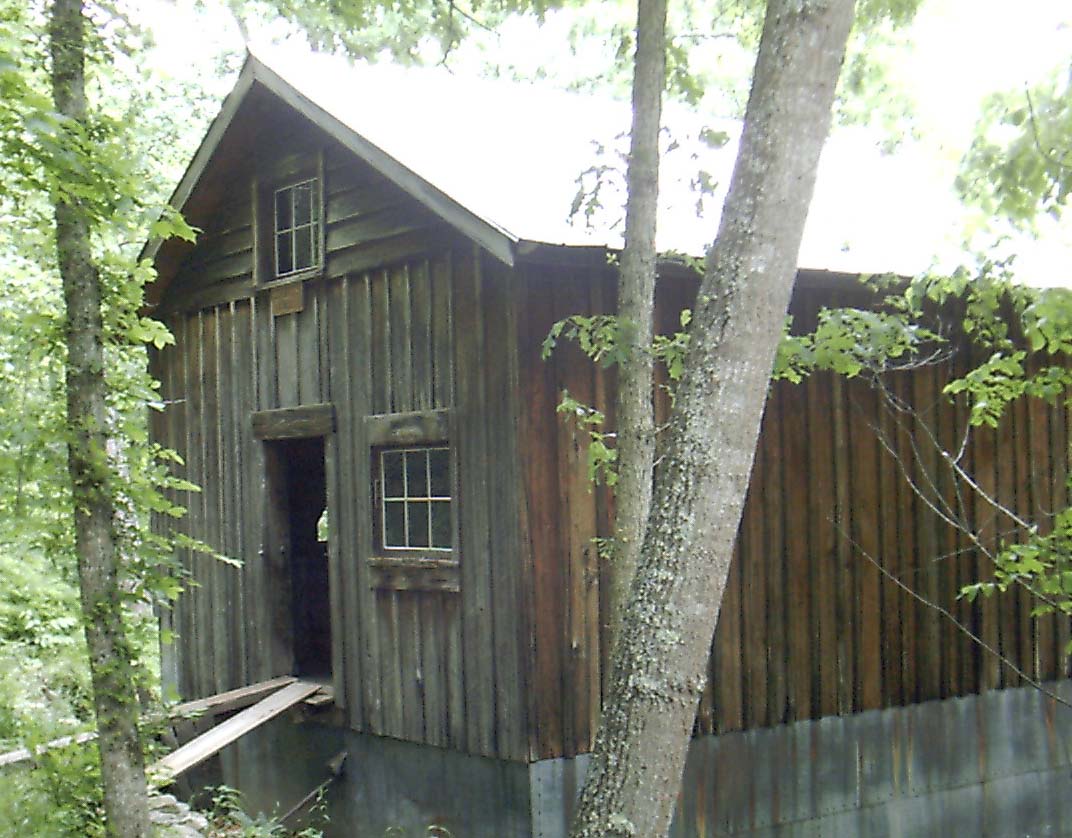
Exercise #1
Describe what you see in this photo. Describe what you don't see-- the interior. Describe the person who comes out of the place. What does the person do?
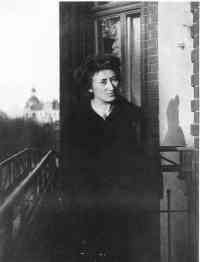
Exercise #2
Write a reflection or short fictional piece about this woman. Where is she? What year is it? What is she thinking? Try this in the form of an interior monologue.
[For those who like only the facts, ma'am, and want to know who she is, click here.]
Exercise #3
You meet a man in a bar in a strange town. He has a cat on his lap, and he orders a cup of coffee, slowly spoons sugar into it. He strokes the cat's black fur and says, "This contact is illusory. The cat and I are separated as though by a pane of glass, because man lives in time, in successiveness, while the magical animal lives in the present, in the eternity of the instant." What do you say back to him? And he to you? What does the cat do? What happened to this man before he came into the bar?
[for the source of the man with the cat in the bar, click here]
Exercise #4 You are in a waiting room (doctor's office, job interview, etc.). People are sitting more or less in a circle. Describe several of them -- focussing only on their feet! Type of shoes, cleanliness and condition of shoes, toes if they show, how they let their feet rest. Are they quiet or do the feet move? What can you tell about the person from the feet?
Exercise #5
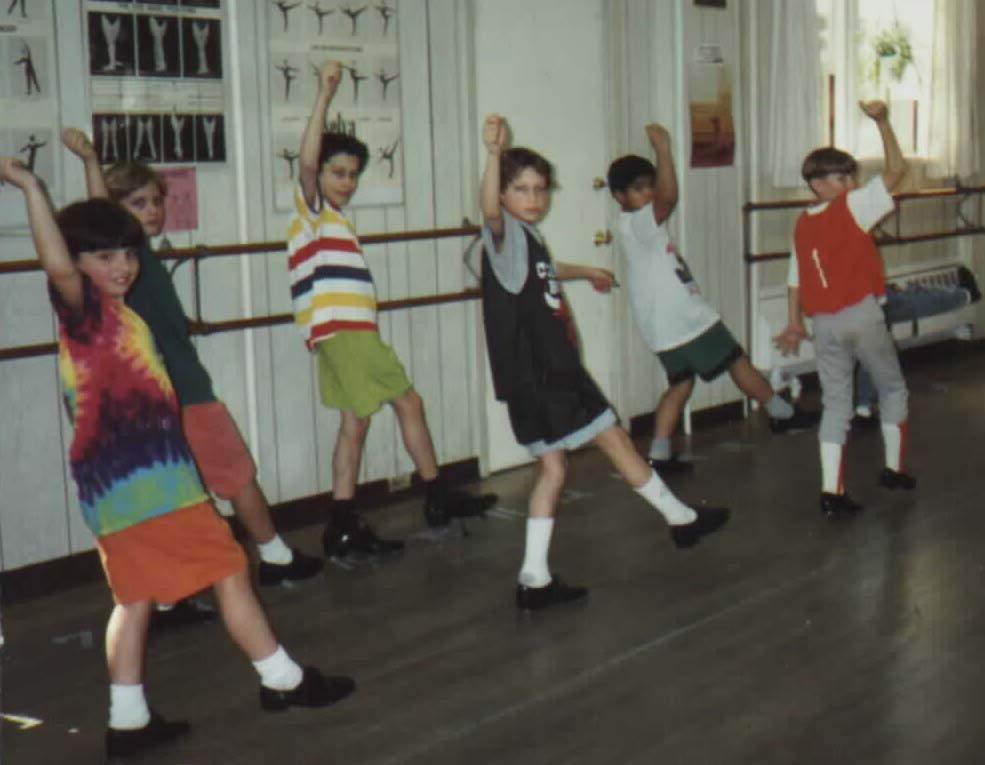
The boys in the picture are marching off-- or are they? Who are they waving at? What will happen next?
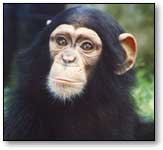
Exercise #6
The chimpanzee is looking into your face. What is she trying to say? What is your response?
Exercise #7
Observe someone's hands (this can be in memory or imagination. Describe them as fully as possible. Notice shape, skin texture, any jewelry or disfiguration. What clues do these hands give you about the person's life?
Exercise #8
Take these lines from a well-known novel and continue them however you want:
She had found a jewel down inside herself and she had wanted to walk where people could see her and gleam it around.....
After you've written, if you really want to, click here to learn the source.
Exercise #9
What is the Parakeet saying to the Cat? And what is the reply?
After writing the dialogue, write the subtext-- what the animals really want or think-- or what the unseen human beings are thinking/doing.
Exercise # 10
Describe a food, using all your senses. Observe it visually, of course, but also include texture, smell and taste. Describe it again, but in a way that makes it disgusting: how a big juice steak, for example, must appear to a vegetarian.
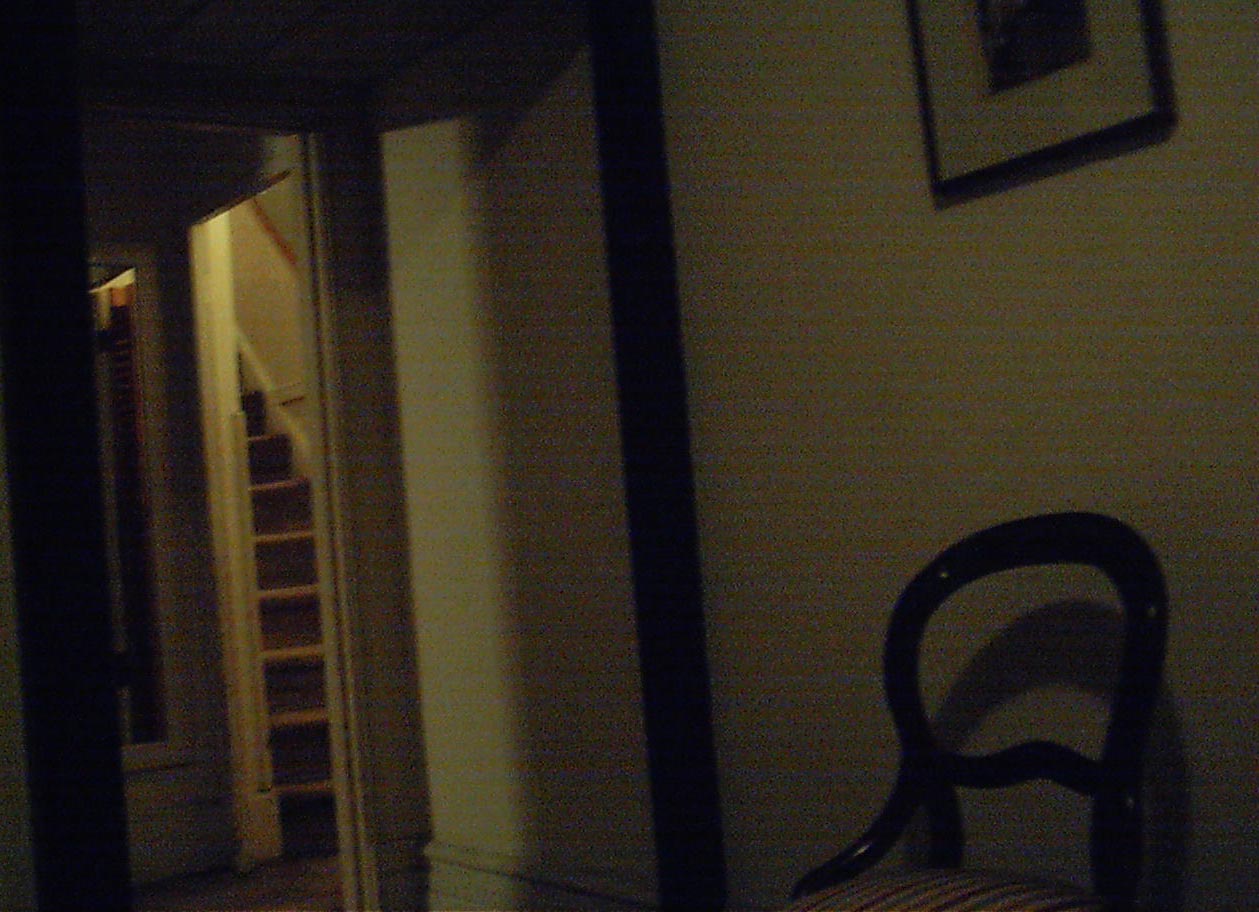
Exercise 11
The room seems to have more shadow than substance, but you can see a staircase through the doorway. Suddenly, down the steps comes....
Exercise 12
One important part of fiction is the small physical gesture that can show so much about a character as well as make the scene jell in a reader's visual imagination. Here's a tiny snippet from Henry James's A Portrait of a Lady:
Madame Merle slowly seated herself, with her arms folded and her white hands arranged as a support to one of them and an ornament, as it were, to the other. She looked exquisitely calm, but impressively sad.
Write a closely observed description of a common gesture or physical action.
Exercise #13
Write a real life memory of a time you had a conflict with someone else. This might have been you with one of your parents, or you with a boss, or any other conflict that comes to mind.
Write the same scene again, but this time from the point of view of the other person.
Exercise #14
Write down an actual overheard telephone conversation - it might be someone in your family or a stranger on the train on his cell phone. I once overheard a man talking passionately with what seemed to be his girl friend - and then calling his wife to tell her what time he'd be home! After you've written the observed half of the conversation, write again, making up what the second person said.
Exercise #15

This Japanese court lady wrote a poem. Imagine you are the translator of her poem. Write it in English as prose or as poetry.
Here is one person's translation of it:
Field Burnt-OverMy body is like
A field wasted by winter.
If only I,
like the field burnt-over,
Awaited the return of spring-- Lady Ise, Japanese Court Lady from 900's CE
Exercise #16
Write a word portrait of one of your great grandparents. All the better if you know only one tiny fact: that she lived in Scott County, Tennessee or that he came to the U.S. rather than be conscripted into the Czar's army. Perhaps this word portrait should be a short poem or the beginning of a short story.
Exercise #17
Dreams are very useful in fiction, as well as fun to write. Sometimes we use dreams to give verisimilitude– they are, after all, a part of life. They can also be used to show a character's mood or even to make a point, as a sort of allegory in the mind of a character. Write a dream for a character in a piece of fiction you are writing or planning.
Exercise #18
Imagine that you are lying in a hammock, gazing up the trunk of tree that
holds the hammock. You are profoundly relaxed; summer is almost over.
Your mind drifts with the slow rocking of the hammock. Your spirit
soars toward the top of the great white pine. Suddenly....
Exercise #19
Sit in your car or on a public bench and observe the people going in and out of a store or public building. Pick out one who catches your attention, and write about who you imagine that person is– where do they live? What are they like? Where are they going next?
Exercise #20
Think of an important event in your life or in a project you are writing. Write the weather for the day it happened. This may require closing your eyes, counting down from ten, trying to empty your mind– whatever works for you to become focused. This exercise, of course, is not just about the weather, but about going deeper into the past by using the sense details of what it felt like to be in that place at that time
Exercise #21
More Dreams: There's a commonly used creative writing exercise to create biographies or back stories for each character in your piece. Try this variation: write the recurring dreams of your four most significant characters.
Exercise #22
Take a notebook and visit a place in your community at a time when it is not too busy. A church or town hall when no meetings are going on would be good, or perhaps the lobby of an office building or a bus or train station on the week-end. Sit in an out of the way place, close your eyes and breathe slowly down from ten, trying to be as empty of thoughts as possible. Count slowly, and do it more than once if you want. When you feel quiet, open your eyes, pick up your notebook and write whatever comes to you.
Exercise #23
Write a dialog in which two people are discussing something very ordinary--what movie to see, who is going to win the championship-- but underlying the quotidian discussion is some serious conflict between them. Show what is going on under the surface.
Exercise #24
A person is choosing a gift for another person. What objects draw the gift giver? What thoughts and memories pass through his or her head? Does the giver reject the first several items? Or see the perfect thing immediately?
Exercise #25
Write a real memory from your early life, if possible from before you started school. Emphasize physical description and sensation. Then, write an early memory that belongs someone else, perhaps one of your parents of a friend. Emphasize physical description and sensation in this other person's memory too
Exercise #26
Write a short monologue for a person (real or made up) who is extremely unlike yourself. That is, if you are an agnostic, write a monologue for a person who believes literally in the holy book of her or his religion. If you think you could never have an abortion, try writing the thoughts of a woman who thinks she absolutely must have one. Maybe even better, try imagining what it would be like to be desperate and pregnant if you are in real life a man!
Exercise #27
If you are having trouble with a writing project, try making up a dream in which your project is a building or a room in a building. This can be a very concrete way to work on the structure of your book. I often have dreams where the most important elements are rooms or structures. Since getting back from Italy, I've been having dreams that take place in the great spacious rooms of palazzos! This exercise is a way to try and get a large project like a novel or memoir into a single thing in your own mind– Not an easy goal for something that you write over months and years and hundreds of pages.
Exercise #28
Write a nonfiction or fiction scene that has a lot of people in it-- a crowd or a group. It could be a party, a church dinner, a class, a bar. Describe the scene using the people as part of the setting: colorful clothes, or a mass of unfamiliar faces, etc. Don't forget the sounds and smells as well as the visual details
Exercise #29
Write a passage of physical action (a dance, someone is running to catch a plane, there is a fight or someone is trying to escape capture). In order to make the action crystal clear, desbribe what happens as if you were filming it using only one camera that is fixed in a single place. This will help organize the action so it is easy for a reader to visualize.
Exercise #30
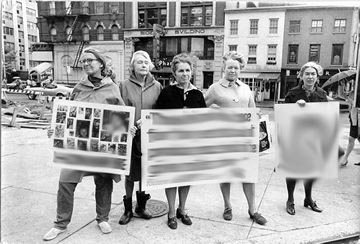
In the photo below, what are the women doing? What are they saying to passers-by? What are they saying to one another? What are they thinking inside themselves?
Exercise #31
Write a character sketch, starting with someone you have once noticed and observed.
1. Begin with a physical description. Try to include more senses than just the visual--how the person sounds, smells, the texture of their hair and skin, etc.
2. Next, write a little about what you can't observe about the person from the outside. This can be facts--job, where the person lives, favorite movie, type of music, etc.
3. Finally, drilling deeper, write some secret or dream of the person--something that perhaps no one knows.Exercise #32
Write down one end of a telephone conversation of someone in your family or a stranger. Given the ubiquity of cell phones, this should be easy to find. Next, write the other half of the dialogue, making up the second person's words. Later, continue the dialogue with what came before it and what comes after....
Exercise #33
Draft a dialogue with food in it. This could be memoir writing or a new scene for some fiction you are working on. Are the people talking directly about the food or just ignoring it? Do their words get garbled as they gobble, or do they just pick at the odd spear of asparagus and concentrate on talking? Try to make the food an active part of the dialogue--not the subject necessarily, but an important part of the scene.
Exercise #34
I am too short to see the top of the table. I stand on my tip toes. I see.....
Exercise #35
There is a famous scene in Tolstoy's epic novel War and Peace in which a direly wounded Russian character, Prince Andrei, is lying on the battlefield--and Napoleon rides by. (You can read the scene online at War and_Peace). Prince Andrei observes the leader of his enemies as he goes in and our of consciousness and hears him
speak (all upper class Russians back then spoke French as easily as Russian).
Try for yourself a scene from real life or in fiction when an ordinary person has an interaction with, or at least sees from a distance, some famous person. It can be anything from your first glimpse of a beloved athlete in the flesh to a fictional scene in which a historical figure-- the Cuban dictator Fulgencio Batista? -- tries to pick up your main character in a bar in Portugal?
Exercise #36
One of the important things in good prose writing is to have more than one thing happening at once. In this exercise, describe a kiss, taking your time and trying to visualize the action clearly and precisely. However-- have something else going on at the same time. Maybe one person is thinking of a different boyfriend, or perhaps someone's leg is falling asleep, or maybe one person is worried about the garlic pizza he had for dinner.....
Exercise #37
A character (or you, if you are writing memoir) thinks about a fear. This could be something practical, like the upcoming results of a medical test, or something vague and indefinite...
Exercise #38
Describe a minor character in your memoir or fiction focussing on showing character through clothes, as in this paragraph from a Jean Stafford Story called "The Tea Time of Stouthearted Ladies," available in The Collected Stories of Jean Stafford.
Every morning, as the girls and the wranglers drowsed through their breakfast of flapjacks and side meat, Miss Skeen appeared in the outer doorway of the kitchen, a homicidal German shepherd at her side (his name was Thor and he lived up to it; he had bitten many ankles and had abraded countless others), and boomed through the screen, “Howdy, pardners!” Miss Skeen, a tall and manly woman, combined in her costume the cork helmet of the pukka sahib, the tweed jacket of the Cotswold squire, the close-fitting Levi’s and the French-heeled boots of the wry American cowboy, and the silver and turquoise jewelry of the colorful Southwestern aborigine. Her hair was short, her face was made of crags, she spoke in a Long Island basso profundo....
Exercise #39
A character (or yourself for memoir) is looking into the refrigerator of someone rather unfamiliar. What can the character learn about the other person by observingthe contents of the refrigerator? What can the character learn about her or his own feelings toward the owner of the refrigerator?
Exercise #40
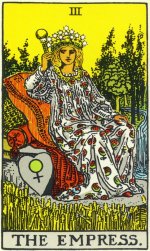
You are having your cards read. You receive "The Empress." The card reader expresses amazement and tells you the following.....
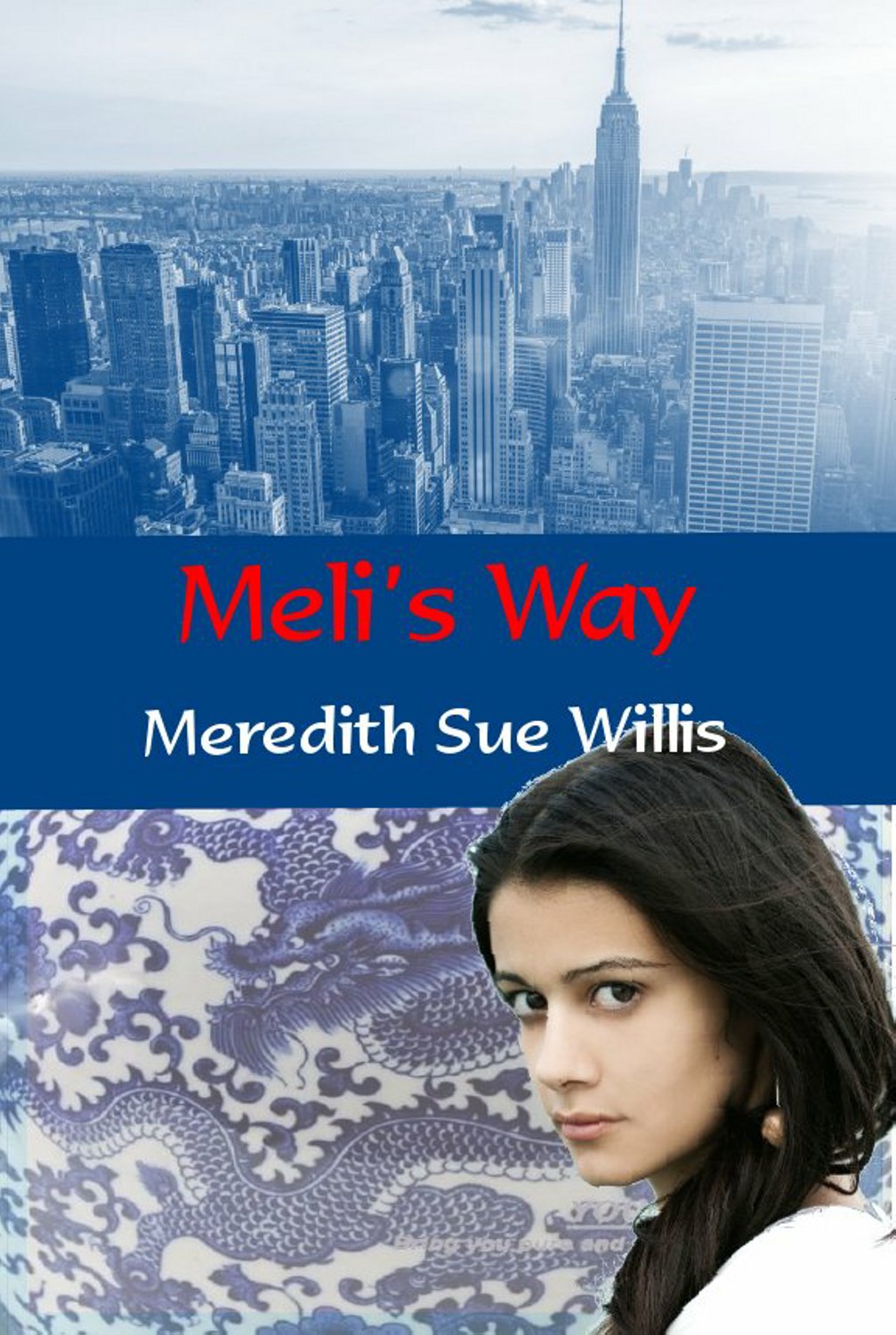
MSW's 2010-2011 Books:



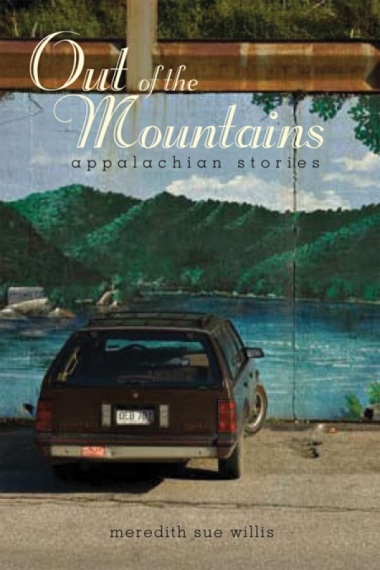
Out of the Mountains: This book is availble from the ususal online suspects plus directly from the publisher here. Sample story at "On the Road with C.T. Savage"
Ten Strategies to Write Your Novel: The book is available through your favorite book store, online from various stores like Barnes & Noble and Amazon.com or directly from Montemayor Press, e-mail: montepress@aol.com P.O. Box 526 Millburn, NJ 07041. For a sample from the book, click here.
Re-Visions is Meredith Sue Willis's latest book. See special deal below!
Subscribe to Meredith Sue Willis's
Free Newsletter
for Readers and Writers:
Send email to MSW
New Book Deal!
[For all of MSW's books, click here.]
Special Price on Meredith Sue Willis's new book of stories from myths and other stories: Re-Visions. Regular Price $14.95 plus S&H now $13.00 plus S&H.
Click on the Book or here.Re-visions: Stories from Stories is a collection of spin-offs from myth, fiction, and the Bible. From a new look at Adam and Eve and why they left the Garden to a grown-up Topsy from Uncle Tom's Cabin to the confessions of SaintAugustine's concubine- each story offers a gloss on the original as well as insights into how we canlive today.
Images and photos found on the various pages of this web site may be used
by anyone,
but please attribute the source when it is specified.
This work is licensed under a Creative Commons Attribution-NonCommercial-ShareAlike 3.0 Unported License.